Capabilities · in depth

Everything FT-TAK does, and how it does it.

From certificate enrollment and built-in Let's Encrypt to auditing, CasEvac, geofencing and a full plugin system — here's the detail behind the feature list, and why a compiled .NET 9 rewrite outruns the Python server it replaces.

Certificate enrollment

FT-TAK runs its own certificate authority. ATAK, iTAK and WinTAK enroll themselves against it over the HTTPS enrollment port — no manual .p12 shuffling, no truststore imports by hand.

  • signClient/v2 CSR signing with HTTP Basic or QR one-time-token auth — the CSR's common name becomes the device identity.
  • Own CA mints and revokes client certs, publishes a CA-signed CRL, and force-disconnects revoked live sessions.
  • XML/JSON content negotiation so ATAK (which only parses the TAK Server XML enrollment document) connects cleanly.
  • Device profiles ride along on enroll and connect — preferences, truststore and install-on-enrollment APKs.
:8446 enrollment/Marti/api/tls/configsignClient/v2CA-signed CRL
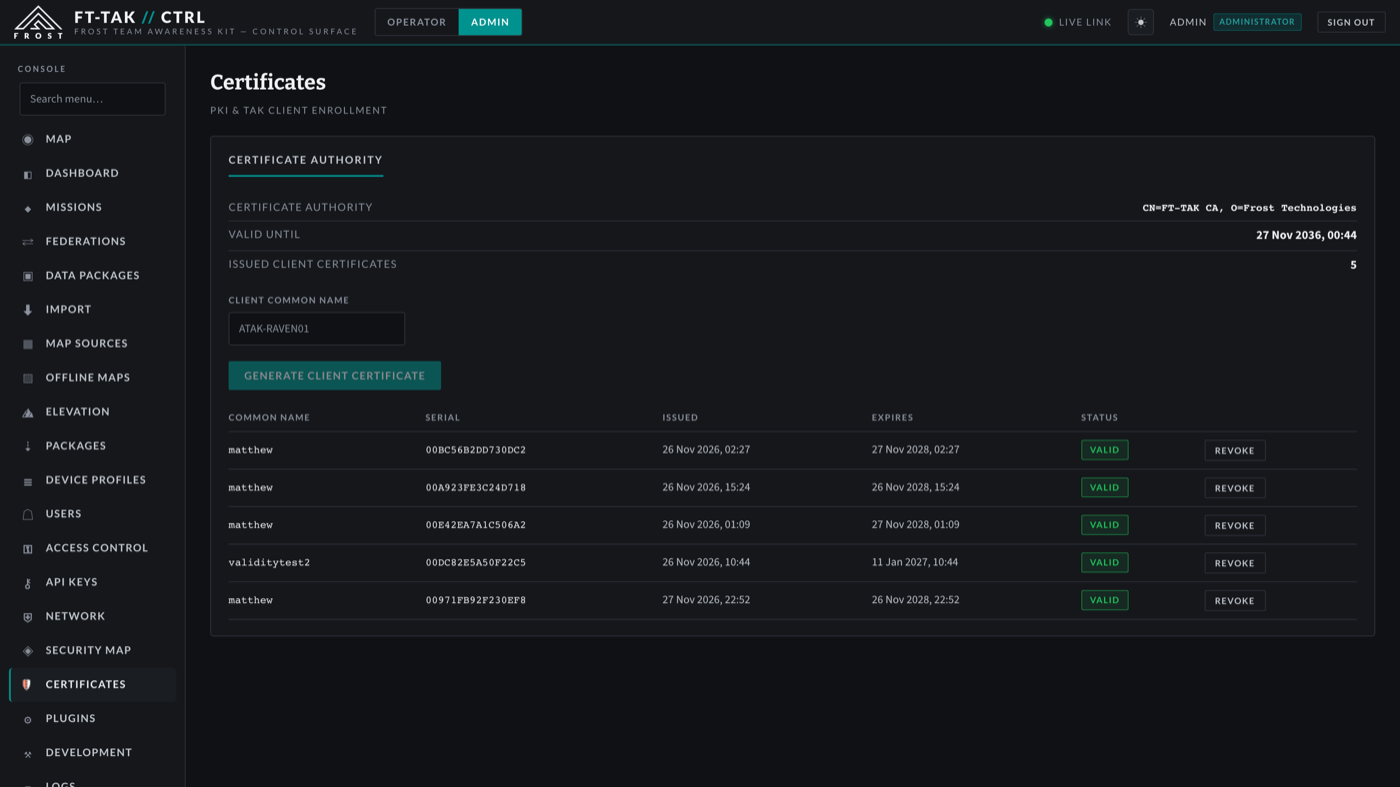
FT-TAK certificate authority admin page

Built-in Let's Encrypt

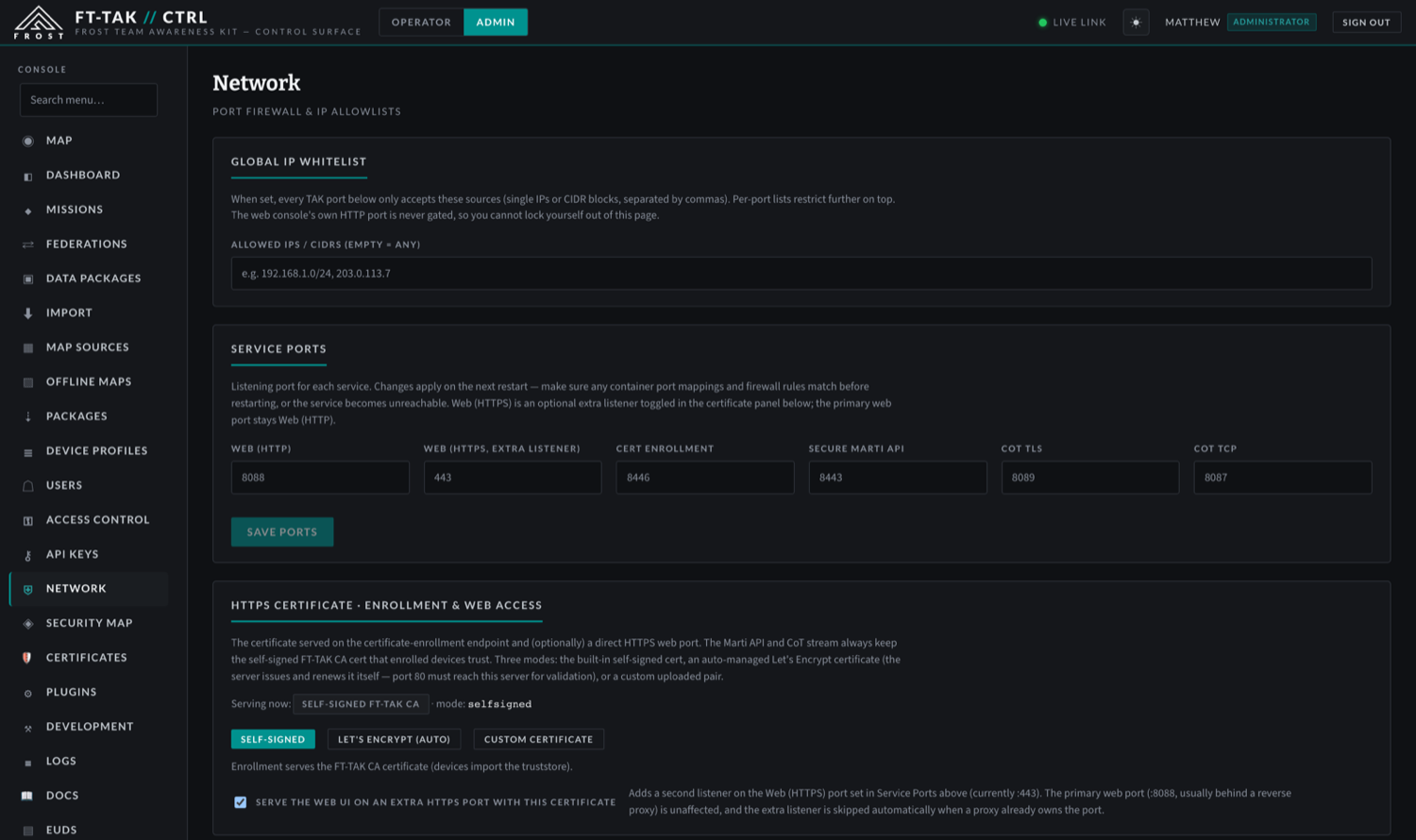
A real ACME client ships inside the server. Enter a DNS name and email, accept the terms, and the enrollment endpoint presents a publicly-trusted certificate — so a device can enroll with no truststore import at all.

  • Answers HTTP-01 challenges on /.well-known/acme-challenge — just reach the server on port 80.
  • Auto-renews within 30 days of expiry via a scheduled job; a successful issue restarts the server by itself.
  • Per-listener certificate choice: the enrollment port and optional HTTPS web port serve the public cert; the mTLS Marti and CoT ports always keep the FT-TAK CA that EUDs trust.
  • Or bring your own — upload a fullchain.pem + privkey.pem pair, validated before it's accepted.
ACME HTTP-01auto-renew 30dAdmin → Network
FT-TAK network page with Let's Encrypt and per-listener certificate settings

Auditing & event trail

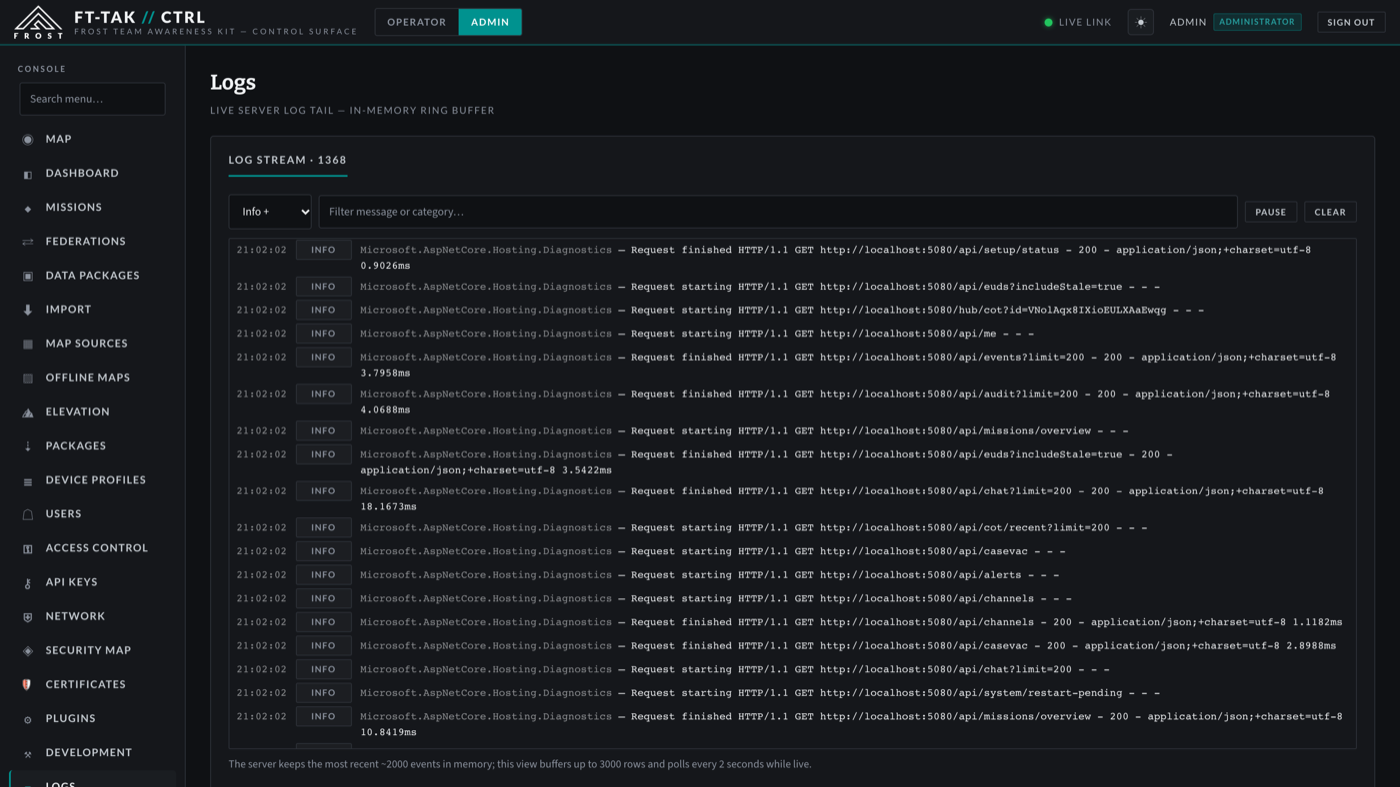
Every consequential action lands in an audit trail with the actor, action, target and detail — surfaced live in the operator's Audit feed and queryable over the API.

  • Logins and logouts, channel toggles, mission changes, geofence crossings and admin mutations — all recorded with the resolved actor.
  • A separate server-event feed (deletes, mission activity, alerts) streams to the web over SignalR with one-time REST backfill.
  • Device-profile pulls are audited too — you can see exactly which EUD fetched its profile and when.
  • The audit feed itself streams live to admins over SignalR — an admins-only channel, so new entries appear the moment they're written.
  • Retention sweeps keep the trail bounded; records age out on a schedule you control.
GET /api/auditGET /api/eventsactor · action · target
FT-TAK live log and event view

CasEvac & 9-line MEDEVAC

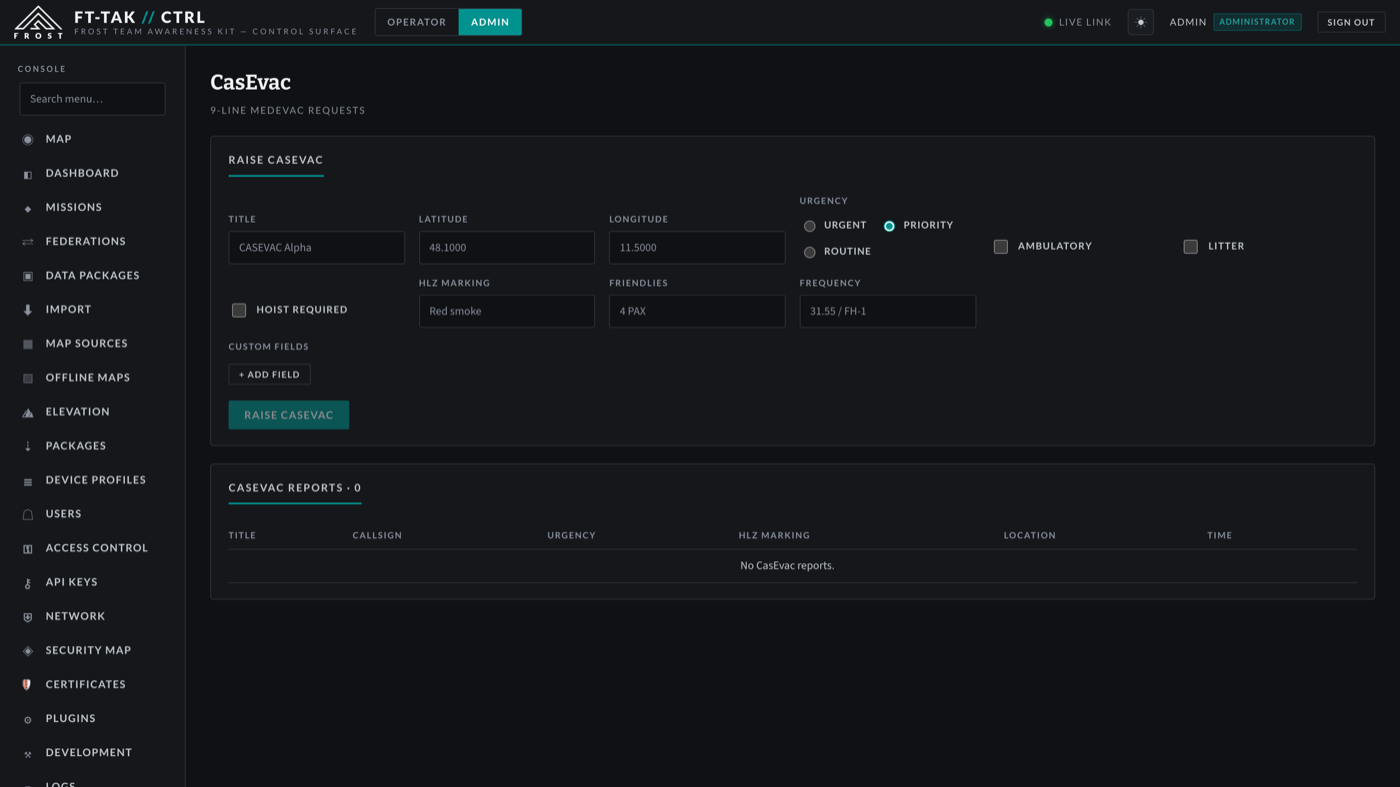
Raise, review and clear 9-line MEDEVAC requests from the console or the operator map — and they open natively in ATAK, because they're real CasEvac CoT.

  • List and inspect active CasEvac reports with the full 9-line and ZMIST detail (zap, mechanism, injuries, signs, treatment).
  • Create a request that renders as a native CasEvac on every connected TAK client.
  • Delete with fan-out — clearing a request removes it from devices too.
  • Draw it straight on the browser map with the CasEvac tool, by affiliation.
b-r-f-h-c9-line + ZMISTnative in ATAK
FT-TAK CasEvac admin page

Geofencing

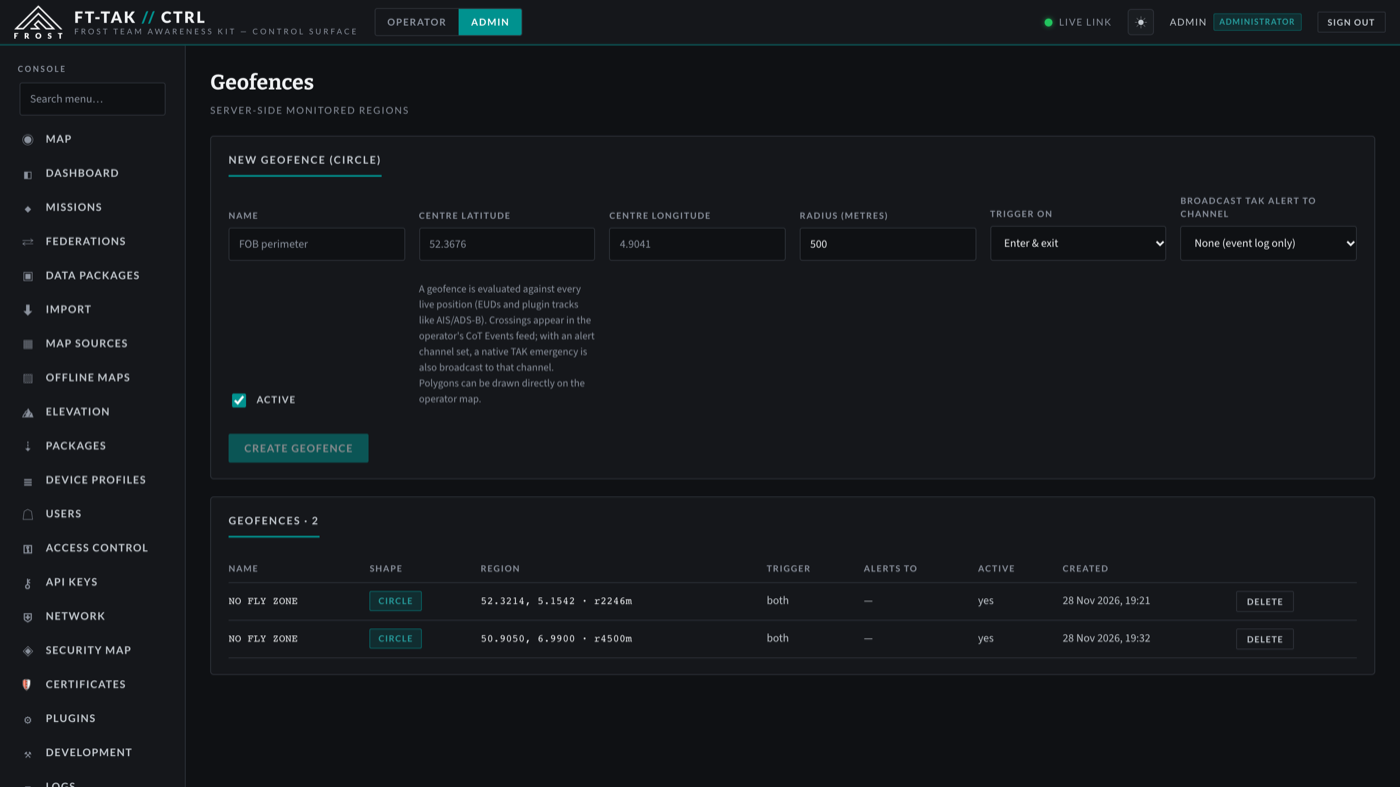
Server-side monitored regions — something ATAK alone can't do. Define circles or polygons; the server evaluates every live position against them and reacts the moment a track crosses.

  • Circle and polygon fences with precise containment (haversine + ray-casting), evaluated against EUDs and plugin tracks like AIS/ADS-B.
  • Enter and exit crossings recorded as CoT events in the operator's feed, with per-fence, per-track state.
  • Optional native TAK emergency broadcast (b-a-g) to a chosen channel on breach.
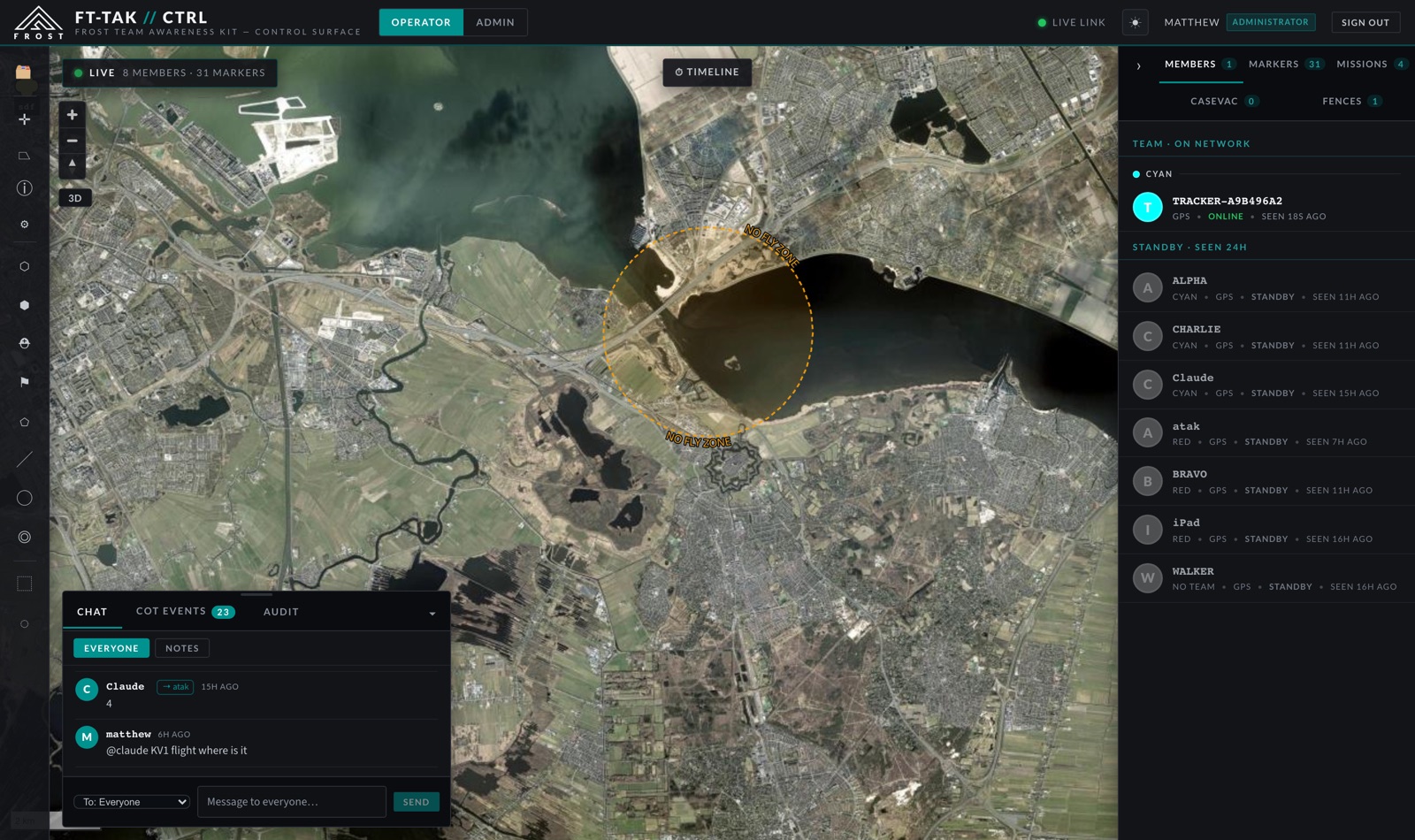
  • Draw circles on the operator map; manage everything from the Geofences console.
circle / polygonenter · exit eventsb-a-g alert
FT-TAK geofences admin page

Missions & Data Sync

Missions are TAK Data Sync feeds — named containers of map objects and files that subscribed devices keep in sync. FT-TAK serves them over the standard Marti Data Sync API, so missions created on the server appear in ATAK's mission list natively.

  • Create missions from the console, the web map or ATAK itself — with the public/vbm tool tags and the full-UUID mission ids ATAK insists on.
  • Every change lands in a change journal (CREATE_MISSION, ADD_CONTENT, REMOVE_CONTENT) — web-map edits and Marti-route edits share it, so ATAK subscribers and the browser stay in sync with each other.
  • Mission files ride the hash-addressed sync store — devices presence-check by hash and fetch content over /Marti/sync, the same way data packages move.
  • Devices subscribe and unsubscribe themselves; the mission's items, subscriber list and change log are all inspectable on the operator map's mission panel.
/Marti/api/missionschange journal/Marti/sync/content?hash=tool: public / vbm
FT-TAK operator web map, where mission content is managed

Maps, terrain & offline

One tile-source catalog feeds the web map and every EUD — and when a deployment goes somewhere disconnected, the server builds the offline imagery and terrain packages itself.

  • Map sources — add a {z}/{x}/{y} URL or import ATAK customMapSource XML (WMS/WMTS/multi-layer too); export per-source or all-custom XML, and every source rides the enrollment profile onto freshly enrolled devices.
  • Tile-cache proxy — the web map's basemaps are proxied and cached server-side; offline downloads consult the same cache first and prime it on the way through.
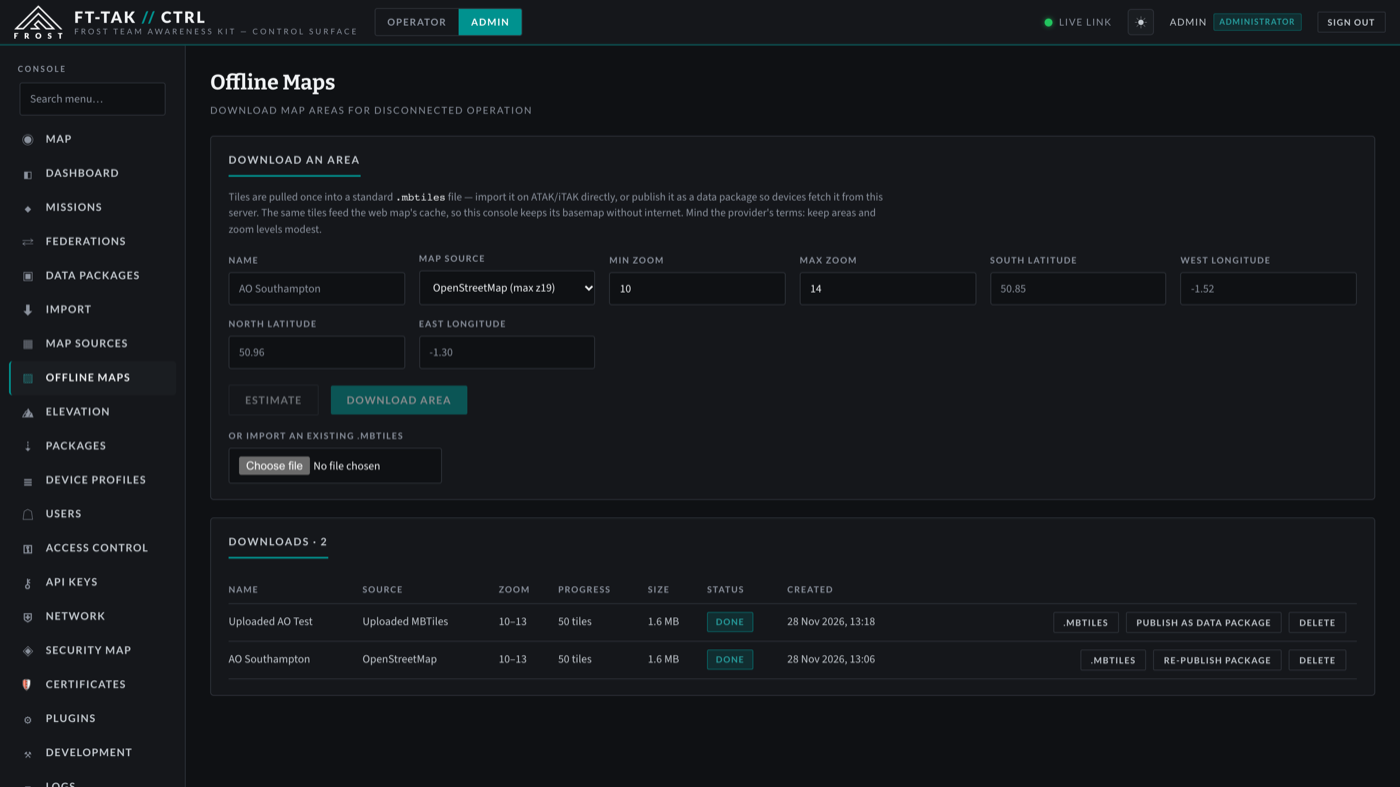
  • Offline maps — queue a bounding-box + zoom-range download (estimated first, capped at 250k tiles) into a standard MBTiles file, or import your own; publish it as an ATAK-ready data package in one click.
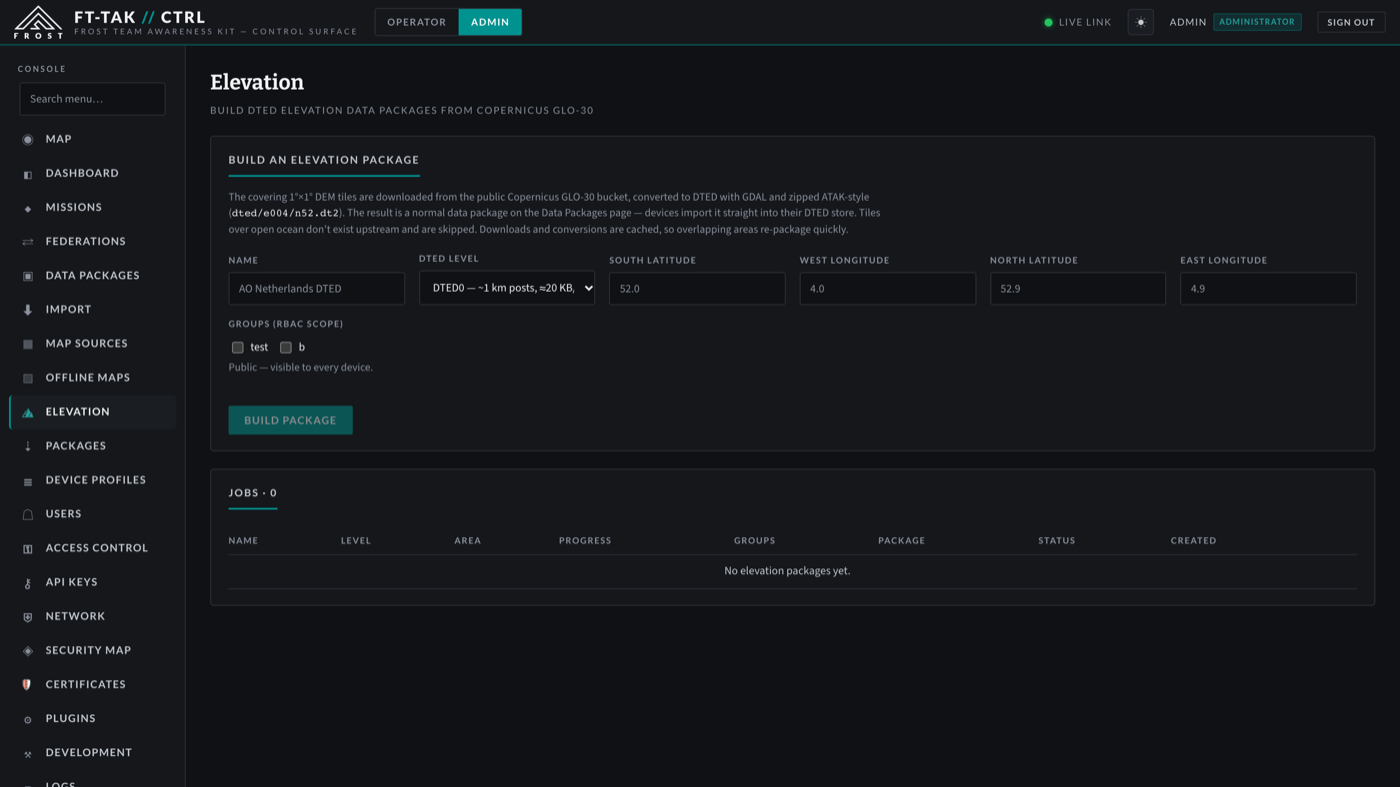
  • Elevation — build DTED 0/1/2 terrain packages from the public Copernicus GLO-30 DEM for any bounding box, zipped ATAK-style and scoped with normal data-package RBAC.
customMapSource XMLMBTiles · ≤250k tilesDTED 0/1/2 · GLO-30server tile cache
FT-TAK offline maps admin page with MBTiles area downloads
FT-TAK elevation page building DTED packages from Copernicus GLO-30

User management & access control

Accounts, roles and routing in one place — with a Security Map that ties every certificate and device back to a person.

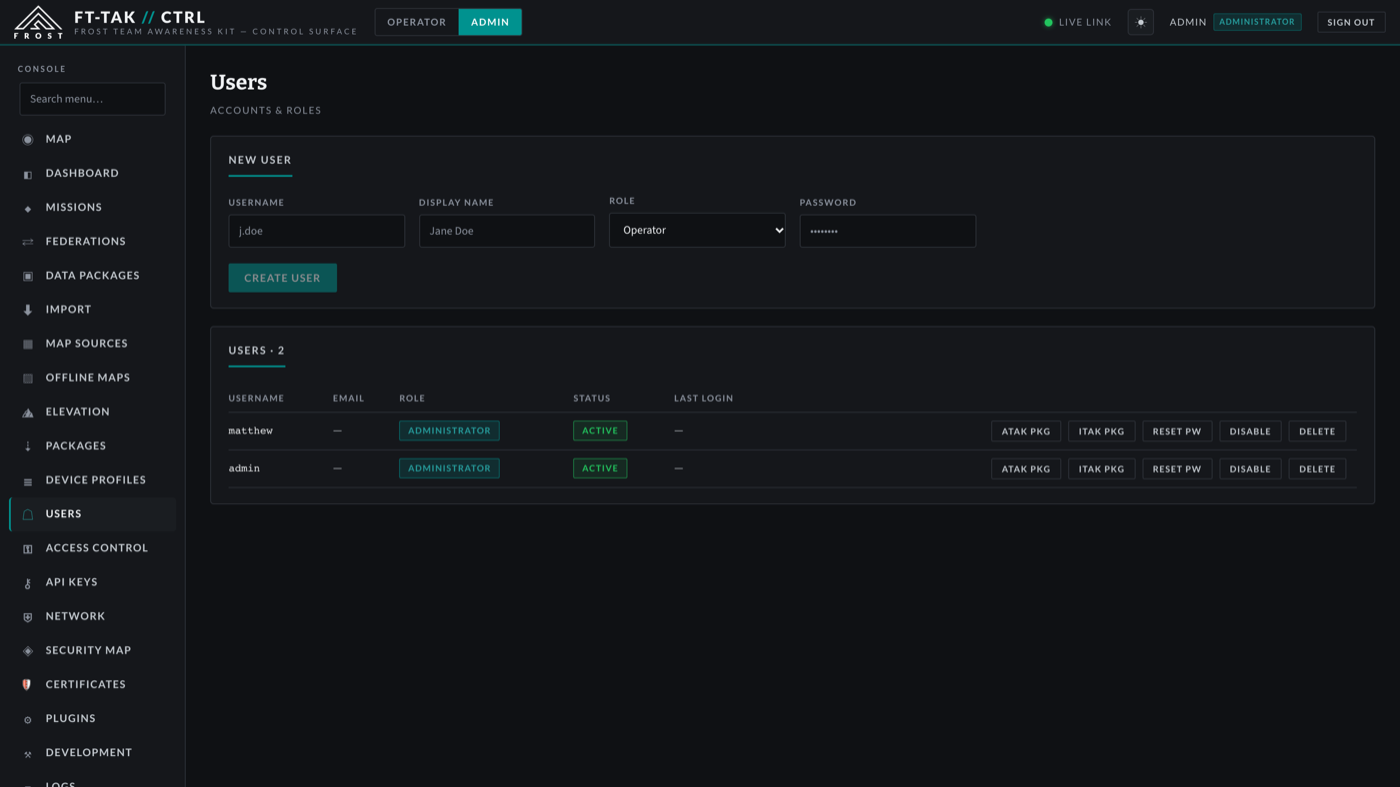
  • Create, role-assign, disable and delete accounts; reset any user's password (PBKDF2, never serialized).
  • RBAC with channels and groups — per-user and per-group IN/OUT grants decide which CoT reaches whom.
  • Per-user ATAK/iTAK connection packages: CA truststore + a fresh client cert + TLS profile, one click.
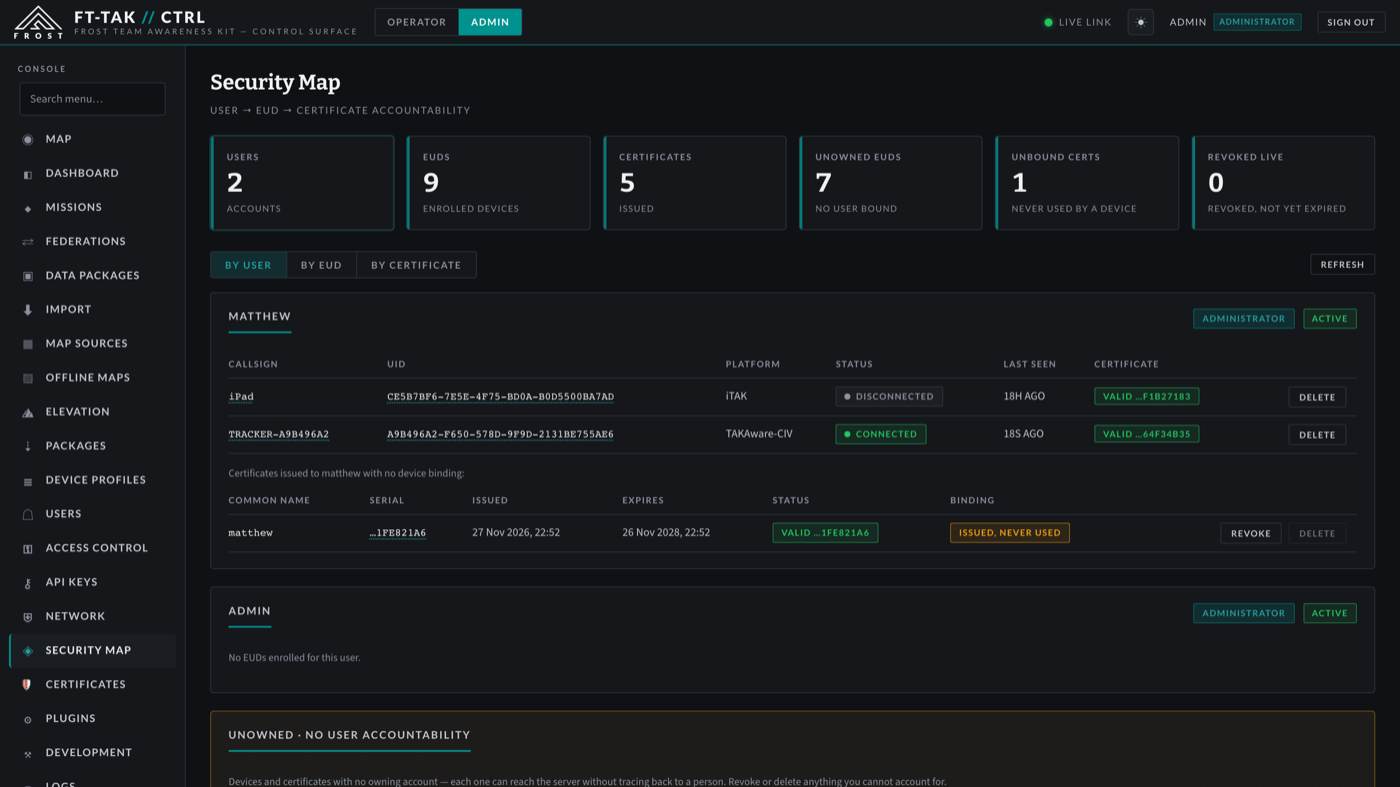
  • The Security Map pivots user → EUD → certificate, flags unowned devices and unbound certs, and revokes in place.
RBAC roleschannels & groupsPBKDF2Security Map
FT-TAK users admin page

Security model

Defence in depth, end to end: mutual-TLS transports, a certificate authority you own, role-based routing, a port firewall, and an accountability view that traces every credential back to a person.

  • Mutual TLS on the CoT stream (:8089) and secure Marti API (:8443) — Kestrel terminates its own TLS and authenticates the client certificate directly.
  • Your own CA issues and revokes client certs, publishes a CA-signed CRL, and force-disconnects revoked sessions already on the wire.
  • Port firewall — per-listener enable plus IP/CIDR allowlists and a global allowlist for the TAK ports; the web/API port is never gated, so you can't lock yourself out.
  • RBAC & identity — channels and groups gate CoT routing, PBKDF2-hashed passwords (never serialized), bearer tokens and scoped API keys.
  • Accountability — the Security Map pivots user → EUD → certificate, flags unowned devices and unbound certs, and revokes in place; every consequential action hits the audit trail.
mTLS :8089 / :8443CA + CRL + revocationIP allowlistsPBKDF2

FT-TAK is open source and self-hosted — you review the code and run it on infrastructure you control. It is young software under active development; audit it for your own threat model before production use.

Found a vulnerability? Report it privately via GitHub security advisories.

FT-TAK Security Map — user, EUD and certificate accountability

Plugins — deep dive

A typed in-process SDK: plugins register HTTP endpoints, scheduled jobs, settings schemas and CoT ingest filters. Built-ins ship enabled-to-taste; drop a .zip (sha256 + zip-slip guarded) to add your own. Each built-in has a deep-dive page in the docs.

Speed & performance

FT-TAK is a ground-up rewrite of the Python OpenTAK server on compiled .NET 9. The architecture is the performance story: one async process instead of an interpreter plus a broker plus worker pool.

FT-TAK · .NET 9
  • Compiled & JIT-optimised — no per-request interpreter overhead.
  • In-process CQRS broker fans out CoT with no message-queue round-trip.
  • Async hosted-service listeners — one shared connection core for plaintext, mTLS and protobuf.
  • GPU track layer renders thousand-contact ADS-B/AIS feeds on the web map without jank.
  • SQLite or Postgres via EF Core — zero-dependency dev, scale-up prod.
Python TAK server
  • Interpreted CPython — Flask/Flask-SocketIO on gevent green threads.
  • Separate message broker (RabbitMQ) for CoT fan-out — extra process, extra hops.
  • Cooperative green-thread concurrency on a single GIL-bound interpreter.
  • DOM-marker map rendering strains under dense feeds.
  • More moving parts to deploy, monitor and keep in sync.

Positioned on architecture, not synthetic benchmarks — the point of the rewrite is a single, compiled, async process with fewer moving parts. Your numbers will depend on hardware, fleet size and feed volume.

How FT-TAK compares

Four TAK servers with public source, side by side — on verifiable facts only. No performance claims about anyone else's software; where we couldn't verify something, the cell says so.

As of November 2026, from each project's public documentation — corrections welcome via GitHub issues. Legend: ✓ documented  ·  partial see footnotes  ·  — not found in the project's public docs  ·  ? unverified.
Capability FT-TAK TAK Server (TPC) OpenTAKServer FreeTAKServer
License & source MITfull source on GitHub GPL-3.0 source on GitHubofficial builds via TAK.gov1 GPL-3.0GitHub + PyPI EPL-2.0GitHub + PyPI
Language / runtime C# · .NET 9single async process Java · SpringPostgreSQL required Python · FlaskRabbitMQ + nginx required Python
Built-in web TAK client ✓operator map in the browser ✓WebTAK2 partialweb UI with live map3 partialseparate WebMap component4
Browser admin UI ✓ ✓ ✓OpenTAKServer-UI ✓FreeTAKServer-UI
Device cert enrollment ✓signClient/v2 + QR one-time token ✓reference implementation ✓ —
Plugin system ✓.NET SDK + zip upload ✓Java plugin SDK ✓Python plugins ?
Federation partiallink management today5 ✓incl. Federation Hub —listed as planned6 ✓FTS-to-FTS Federation Service
Missions / Data Sync ✓Marti Data Sync API + change journal ✓ ✓Mission API —ExCheck task lists documented7
Docker deploy ✓compose files in repo ✓via TAK.gov1 ✓Dockerfile in repo ✓Dockerfile + compose in repo
  1. Official TAK Server builds (including the Docker bundle) are distributed through a TAK.gov account; the GitHub repository carries the source.
  2. WebTAK, the browser TAK client, is bundled with official TAK Server distributions.
  3. OpenTAKServer-UI is a web admin with a live map view rather than a full browser TAK client.
  4. The FreeTAK WebMap ships as a separate FreeTAKHub component, not inside the server itself.
  5. FT-TAK federation currently manages federation links (endpoint, protocol V1/V2, enable/disable); the connection transport is under active development.
  6. Federation appears under "Planned Features" in the OpenTAKServer README.
  7. FreeTAKServer documents ExCheck task-list sync; Data Sync mission feeds are not listed in its public feature set.

See it for yourself.

Every capability here ships in the box. Clone FT-TAK, bring up the stack, and enroll a device against your own CA.